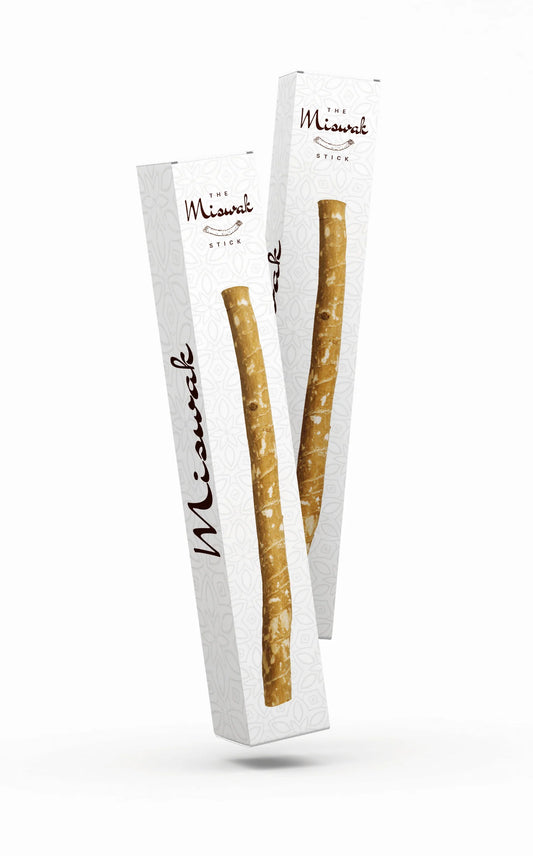
Yes, a miswak fades once it is cut, because the part that kills bacteria is never stored in the miswak at all. Your mouth makes it when you chew a fresh tip.
A Miswak Killed Bacteria Without Touching Them
In 2008 researchers put miswak pieces onto dishes of bacteria in two ways. Some pieces were pressed down into the jelly so that they touched the bacteria, and other pieces were held in the air above the dish, touching nothing at all. [Sofrata et al., 2008]
Both sets of pieces stopped the bacteria growing. The pieces held in the air actually did better against two gum-disease bacteria than the pieces pressed into the jelly did. [Sofrata et al., 2008]
Those bacteria could only have died if something left the wood and crossed the gap of air on its own. Anything that can cross a gap in a dish can also drift away from a stick on a shelf.
Your Mouth Makes The Germ Killer, The Miswak Does Not Store It
In 2011 the same researchers named the compound that does the killing. It is benzyl isothiocyanate, a natural antibacterial from the same chemical family as the heat in mustard and horseradish. [Sofrata et al., 2011]
A miswak keeps none of that compound ready made. The miswak stores two harmless ingredients separately, and tearing fresh tissue with your teeth is what brings the two ingredients together, which is the moment the germ killer comes into existence. [Wu, Darout & Skaug, 2001]
In plain English: A miswak is a kit with two harmless ingredients stored separately, and biting the tip is what mixes them, so fiber you chewed yesterday has already spent whatever reaction it had.
Month-Old Sticks Tested Weaker Than Fresh Ones In 1997
In 1997 researchers compared freshly cut miswak against miswak that had been kept for a month, and the month-old material came out weaker. So freshness is not a new worry. Researchers first raised it close to thirty years ago.
Grinding a miswak into bristles does the same thing to a miswak, only much harder and much faster. Nobody has tested what is left inside a miswak-infused toothbrush.
A Used Miswak Ends Up Cleaner Than A Used Brush
In 2016 a study asked 12 people to clean one side of the mouth with a miswak and the other side with a nylon toothbrush. On the first day the miswak carried more bacteria than the toothbrush did, because frayed fibers give bacteria more surface to cling to. [Darout & Homeida, 2016]
After a night in storage the result turned around, and the toothbrush held far more bacteria than the miswak did. Bacteria died back on the miswak and survived on the nylon. Twelve people is a small study, though, so treat that as a hint rather than a settled number.
What This Means For The Stick In Your Bathroom
Trim about a centimeter of bark off the tip every day or two and chew yourself a fresh brush, because yesterday's fibers are carrying yesterday's bacteria and have already given up most of what they had.
Store the stick dry, tip upward and in open air, because a sealed case or a cup of water keeps the miswak wet, and a wet miswak grows mold. Mold is why a miswak turns black.
Replace the whole miswak stick every month, and the technique page sets out the full routine along with the reason behind that month.
Where this argument stops: Nobody has taken sticks of a known age and measured how much germ killer is left in each one, so I cannot tell you what is left after two weeks. We are reasoning from the chemistry, and from one comparison published in 1997 in a journal that no longer exists.
FAQs
Does a miswak expire?
Not on a printed date, but a miswak does fade. Sticks kept for a month tested weaker than freshly cut ones in 1997, so replace yours every month.
How often should I trim my miswak back to fresh fiber?
Every day or two. Cut about a centimeter of bark off the tip and chew yourself a new brush.
Is a dried miswak still worth using?
A dried miswak still cleans, because the silica and the fibers scrub whatever their age. What fades is the chemistry that kills bacteria.
References
- Sofrata et al. (2008). Journal of Periodontology, 79(8):1474–1479.
- Sofrata et al. (2011). PLOS ONE, 6(8):e23045.
- Wu, Darout & Skaug (2001). Journal of Periodontal Research, 36(5):275–284.
- Almas, Al-Bagieh & Akpata (1997). Biomedical Letters, 56:145–149. (Journal is defunct and the paper is not indexed.)
- Darout & Homeida (2016). American Journal of Health Research, 4(5):134–137.