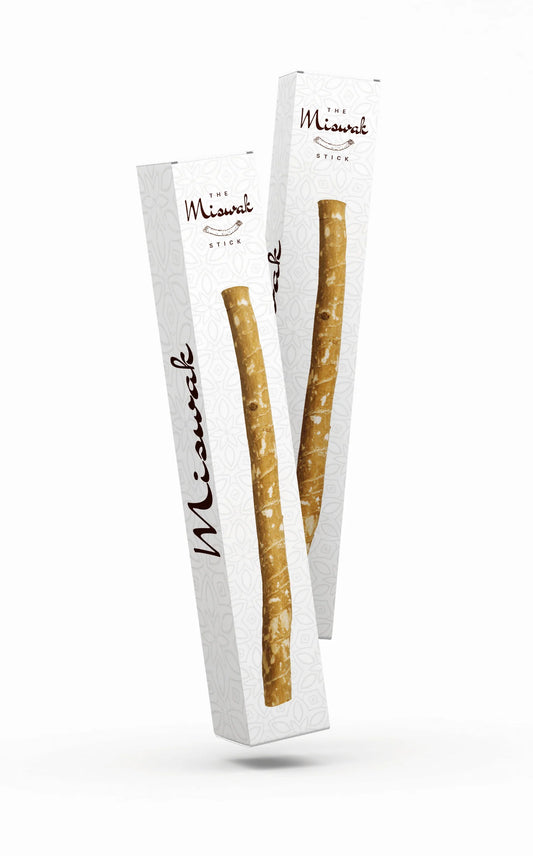
A miswak-infused toothbrush brushes your teeth. The real question is chemical. The part of a miswak that kills bacteria is made only when you chew a fresh stick, and no one has measured whether the ground powder pressed into bristles still makes it.
A miswak-infused toothbrush is ground miswak pressed into bristles
Several brands grind a miswak into powder, mix it into the plastic, and press it into toothbrush bristles at the factory, often months before the brush reaches your bathroom.
It solves a real convenience problem. The brush works the moment you unwrap it, while a raw miswak has to be trimmed and chewed first, and that is where most new users get lost. The technique takes about a minute to learn. The only question worth asking is whether that convenience keeps the part of the miswak that actually matters.
The part that kills bacteria is made when you chew, not before
The value of a miswak is not just that it scrubs. It carries a natural germ-killer, and the evidence for how that works is what this whole question turns on.
1. The active part escapes into the air
In 2008 researchers held pieces of miswak in the air above a dish of bacteria, touching nothing at all, and the bacteria died anyway. [Sofrata et al., 2008]
2. Researchers named it in 2011
The same group named the compound. It is benzyl isothiocyanate, a natural antibacterial from the same chemical family as the heat in mustard and horseradish. [Sofrata et al., 2011]
3. Your mouth makes it when you chew
A miswak does not hold that compound ready to use. It stores two harmless ingredients separately, and chewing a fresh tip is what brings them together. [Wu, Darout & Skaug, 2001]
4. Powder is ground months before you buy it
Miswak powder is ground and dried long before anyone opens the box, so there is no fresh tissue left to tear. A miswak fades once it is cut and dried.
In plain English: A miswak works like a two-part kit that only goes off when you chew it. Grind it into powder months earlier and the reaction has nothing left to start.
What has actually been tested, and what it leaves open
Set against that chemistry, the clinical evidence for infused brushes is thin. The only trial on a product like this is a single three-week study from 2023, run on one branded miswak-bristle brush. It counted plaque and gum bleeding, all three tools in it improved, and it measured no chemistry at all. It also gave fluoride toothpaste only to the standard toothbrush and never says whether the infused brush used any, so its result cannot show whether the ground miswak in the bristles added anything.
So a miswak-infused toothbrush is proven to brush. No study has shown it works like a miswak. Those are two separate claims, and only the first has ever been tested.
Where the evidence runs out: No one has measured how much of the germ-killing compound is left in a shop-bought infused brush. Until someone does, we are reasoning from the chemistry rather than from a measurement, and that is the weaker position. If a lab measured those bristles and the reading came back strong, this article would be wrong, and I would rather say so now.
The whole miswak has the evidence the powder lacks
The contrast is the point. Nine trials read together in 2022 found a miswak used on its own cleans about as well as an ordinary toothbrush, and better alongside brushing. That evidence is for the whole stick, the form that still makes its chemistry when you chew it, and not for ground powder set in bristles.
One clean detail from the 2023 trial points the same way. A plain miswak stick, using no toothpaste at all, drew level with a toothbrush that had fluoride paste helping it.
The three formats, side by side
| Whole miswak | Miswak-infused brush | Ordinary brush | |
|---|---|---|---|
| Scrubs plaque | Yes | Yes | Yes |
| Makes the germ-killer as you use it | Yes, on chewing | No fresh tissue to trigger it | None |
| Chemistry measured in finished product | Made fresh each use | Never measured | None to measure |
| Ground and dried before sale | No | Yes | Yes |
Sources: 2023 miswak-bristle brush trial; chemistry papers above.
One test would settle this
One simple measurement would close the question. Take a miswak-infused toothbrush bought in a shop, measure how much of the germ-killing compound is left in its bristles, and set that reading beside a freshly chewed miswak. Nobody has run it yet.
Our answer, until they do, is to sell the version whose chemistry is not in doubt — the whole miswak.
FAQ (matches FAQPage schema)
Does a miswak-infused toothbrush work like a miswak stick?
No study has shown that it does. It brushes, but a miswak's germ-killing compound is made only when you chew fresh tissue, and ground powder has none, so no one has measured what is left in the bristles.
Was toothpaste used in the 2023 miswak trial?
Only the standard toothbrush group used fluoride toothpaste, and the plain miswak stick used none. The paper does not say whether the infused brush used toothpaste.
Why would grinding a miswak change its chemistry?
The germ-killer is not stored in the wood. A miswak keeps two harmless ingredients apart, and they meet only when you chew a fresh tip, which ground powder no longer has.
Is a whole miswak stick actually proven to work?
Yes. Nine trials read together found a whole miswak cleans about as well as an ordinary toothbrush on its own, and better alongside brushing.
References
- Sofrata et al. (2008). Journal of Periodontology, 79(8):1474–1479.
- Sofrata et al. (2011). PLOS ONE, 6(8):e23045.
- Wu, Darout & Skaug (2001). Journal of Periodontal Research, 36(5):275–284.
- Azizan et al. (2023). BMC Complementary Medicine and Therapies, 23:456.
- Ramli et al. (2022). Journal of Ethnopharmacology, 298:115598.